

Ankles & emotions
Inside the learning process of the Feldenkrais Method

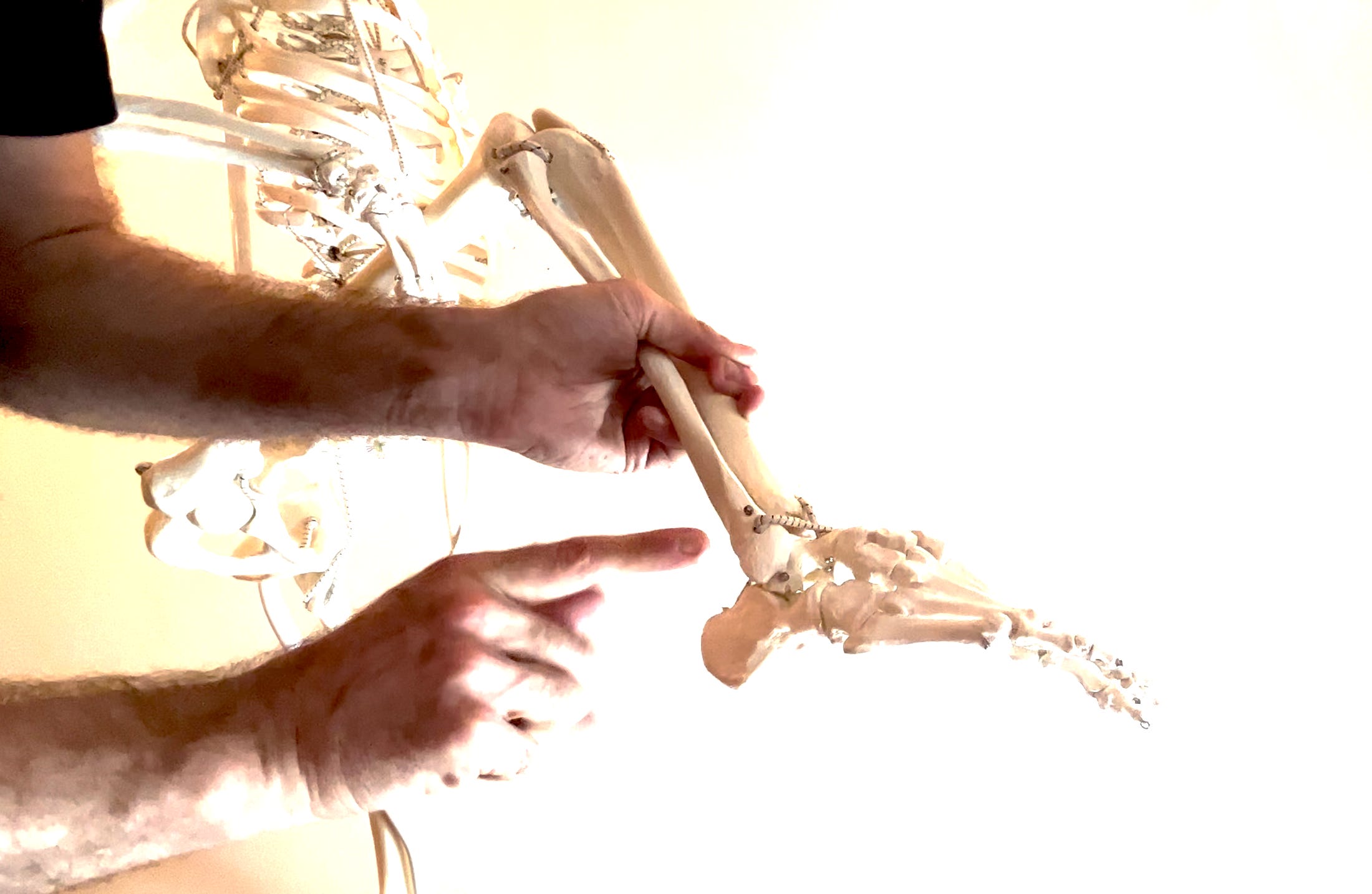
Recently a commenter on my YouTube channel was adamant about correcting me on my wrong-headed proposal that our emotions can be found in our ankles.
Actually I never made such a proposal. 🙄
“Did you watch the video?” I asked.
Ankles & Emotions - Inside the Feldenkrais Learning Process, guides you through a series of movements designed as a somatic inquiry rather than as an exercise.
From the very beginning, there is an assumption that, like with any learning process, frustration, confusion and sensations of awkwardness are to be expected.
Yet these predictable emotional challenges can be prepared for and intelligently responded to as they naturally comes up. Emotional self-regulation through ups and downs can be practiced simultaneously alongside bio-mechanical movement learning.
In fact, if the process is treated primarily as being about the emotional regulation and only secondarily about the movement coordination, the functional improvement is often much more significant what you would get by striving to get things “right.”
In fact, that is discouraged.
“Do it badly,” Moshe Feldenkrais used to say. He said this again and again.
At the very beginning of his Amherst training program, he asked trainees to lie on their backs and gently move their eyes to the right, “and keep doing that.”
Then he told long stories about judo and other things, occasionally reminding everyone to keep taking their eyes to the right. He never gave the instruction to move the eyes to the left.
After some time he asked them to stand and walk around to see how it felt.
Can you see how emotional challenge is being deliberately created and invited?
Over the years, there were arguments over whether the Feldenkrais “dealt with the emotions” or not. I once heard second-hand that Peter Levine, the creator of Somatic Experiencing was asked to speak at a Feldenkrais conference and echoed this view.
Many colleagues heard this as blasphemy on our great guru. Others completely agreed.
Many practitioners have trained in both modalities.
Yet, if you would just read one of Feldenkrais’s books, you would simply be ignorant if you thought he was not concerned with the emotions.
However, rather than creating processes for treating experiences of trauma, Feldenkrais understood that emotion is at the heart of the human learning process and made this question the central investigation of his work. He paid close attention to where, when and how emotions disorient us when we confront what is unfamiliar to us and sought to show us a better way.
He clarified that the continuous and intentional reduction of effort - similar to the approach invited by meditation - makes it possible for us to overcome the obstacles to our understanding, including the embodied understandings necessary to improve motor coordination.
This is why there is so much emphasis in the Feldenkrais Method on slowing down,. Other recurring themes in this practice that are used to navigate emotional obstacles include the identification of habits, deliberate exploration of non-habitual patterns and strategic use of movements performed only in the imagination.
In my Feldenkrais training, as I was just beginning to understand my role as a practitioner - knowing that it had something to do with encouraging a client to reduce unnecessary efforts while exploring unusual movement patterns - I gave my very first hands-on Functional Integration lesson to a willing volunteer.
At the end, I was happy simply that she hadn’t experienced any harm, given that I barely knew what I was doing. I was further gratified that she said she felt more relaxed. Yet I was unprepared for the next thing she told me about her experience:
She said she was completely rethinking her relationship to her daughter.
Huh?!
After a decade of this practice, it no longer surprises me that when people unwind deep unconscious patterns of muscular effort in their body they often get somatic insights into habits of strain that exist in other parts of their lives.
I recently discovered the work of Vivian Dittmar, a wisdom teacher from Germany who specializes in helping people understand the emotions. She maps five primary emotions (like the primary colors) - anger, sadness, fear, joy and shame - which she organizes in her teaching as points around an “Emotional Compass.”
A striking point in Dittmar’s work is that she treats all the emotions as being empty in the sense that she doesn’t assume that they are inherently positive or negative. Rather, for each one, she describes a shadow relationship as well as a “social power.”
On the one hand, anger destroys, sadness depresses, fear paralyzes, joy deludes and shame self-attacks. On the other hand, anger can lead to clarity, sadness to acceptance, fear to creativity, joy to appreciation, and shame to self-inquiry.
Feldenkrais died in 1984, long before Dittmar created her Emotional Compass. Yet, within the vast archive of Awareness Through Movement lessons that he left behind (and which contemporary Feldenkrais practitioners continue to develop in the same way that jazz musicians develop earlier song forms) there are countless embodied inquiries that explore exactly these emotional dynamics within the wordless realms of movement and perception.
It’s worth pointing out that when you’re angry (or sad or scared, etc), you see things differently. That’s why, in the spirit of Feldenkrais, when I teach a person how to discover better functioning of their ankle joints, I highlight the emotional states they are likely to traverse in pursuit of that efficiency.
Shadow emotions distort perception and obstruct learning. But if you place your attention directly in the middle of your embodied sensations - including the unpleasant ones - you have the opportunity to clarify what you feel, move past your blind spots and into new territories of possibility.
Much more could be said on this topic, but what would be much better is to experience for yourself - in your body - this wordless wisdom.
I always need to remember not to see through the lenses of anger