

The postures of love
Starting with the belief that the beloved is worthy of love, everything else unfolds

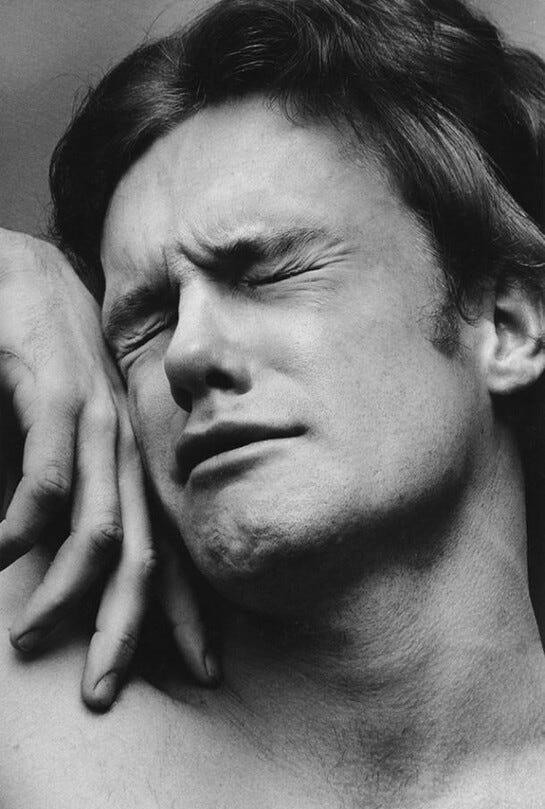
‘Orgasmic Man’ by Peter Hujar,
which appears on the cover of ‘A Little Life’ by Hanya Yanagihara
Each one of us “rises to the occasion” under the right circumstances. One way to understand these moments is that they are expressions of love.
Our “best” emerges from love because love clarifies intention, attunement, motivation, courage and participation.
When I am grounded in love, I listen better. I am more poised, less judgmental, more discerning. I have access to more inspiration and intuition.
A vision of the happiness of my beloved (who could be me) illuminates the true north of my compass differently than any other vision. With this orientation, I am wise in ways that normally I am not. I am more intimately in contact with my inner motivations. On these occasions, I realize the direct correlation between the quality of my attunement and my actions in the world.
In A Little Life by Hanya Yanagihara, a young man named Willem wants to travel home from college to care for his disabled brother. He is discouraged from doing so by his cold and indifferent parents, who see the trip as a wasted effort. Additional obstacles are the cost and logistics of travel and his upcoming midterm exams.
Finally, drunk that Friday night, he confided in Malcolm, who got out his checkbook and wrote him a check.
“I can’t,” he said, immediately.
“Why not?” asked Malcolm. They argued back and forth until Willem finally accepted the check.
“I’ll pay you back, you know that, right?”
Malcolm shrugged. “Theres no way for me to say this without sounding like a complete asshole,” he said, “but it doesn’t make a difference to me, Willem.”
Still, it became important to him to repay Malcolm somehow, even though he knew Malcolm wouldn’t accept his money. It was Jude who had the idea of putting the money directly into Malcolm’s wallet, and so every two weeks after he’d cashed his check from the restaurant where he worked on the weekends, he’d stuff two or three twenties into it while Malcolm was asleep. He never quite knew if Malcolm noticed - he spent it so quickly, and often on the three of them - but Willem took some satisfaction and pride in doing it.
Yanagihara’s novel is a deep meditation on the power of friendship, tracing the lives of four men who first meet as college roommates, then stay connected through decades of triumph and tragedy. The power of the love that animates them is especially clarified in the confrontation with unspeakable cruelty and suffering that one among them experienced as a child.
In this episode, with a little help from his friends, Willem demonstrates how love guides us to find ‘right action’ in difficult circumstances. Willem’s love for his brother overrides his parents’ discouragement, brings his frustration into vocal expression when he is at a loss for what to do, allows him to swallow his pride to accept the loan from his friend, and embrace the advice of his other friend to work through his remaining pride related to the reimbursement.
Malcolm freely gives to Willem what is easy for him to give, setting aside concerns about dollars and cents and recognizing his friend’s circumstances. Jude’s creative solution to help Willem fulfill his desire to pay Malcolm back respects the counterposed positions of his two friends, demonstrating skillful attunement.
Love doesn’t offer these friends a formula that tells them what to do (how to come up with money, when to speak openly or keep a secret, or how to balance competing interests). It simply animates each one of them with a resonance that illuminates the pathway towards the next right action.
Or, sometimes love doesn’t resonate - indicating that the right action remains elusive and requires more searching to find.
In challenging circumstances, when we ask, “what shall I do?” the first answer that arises is often “I don’t know.” Yet, when we are grounded in love, we continue to hold the question, turning it over in different ways as we continue to live with it.
When we learn that, in the end, Malcolm continues to freely spend his money on Jude and Willem, despite the secret repayment of his loan, another property of love comes into view. It is not only a current inspiring each man individually. It also flows between them. Malcolm’s forgiving attitude about the loan co-exists with Willem’s insistence that it should be repaid and Jude’s respect for both points of view.
Love sees more than any of them sees individually and it sees things through.
Before it is expressed through embodied action, love is a dispositional state.
Love is a feeling of care, a posture of listening, a buzz of animation, a determination to see things through. While love can’t guarantee success ahead of time, it organizes our being to draw upon the best of what we possess.
When our best efforts still fall short, love calls us to grieve our losses and learn the lessons. Love connects the particularity of what we feel here and now to what is universal and eternal.
Like the proverbial grandmother lifting a car to free her grandchild, you have likely found unlikely solutions to difficulties that at first seemed insurmountable. Love may have guided you to listen longer when you felt impatient, stretch your imagination further to understand someone else’s point of view, investigate connections between seemingly unrelated questions or draw on strength you never knew you had.
While there’s no telling what you might do when you are animated by love, when it brings out your “best”, there are certain ‘postures’ that you are more likely to embody.
You will likely be more kind - to yourself and others. You will likely be more present and more open than usual. You are more likely to test your intuitions by moving into action rather than endlessly ruminating from the sidelines.
Reality is what it is and will not be bent to our will. It is self-defeating to condemn the rain when we wanted sunshine - yet it is entirely justified to recognize and honor our feelings of disappointment. This is the posture of kindness.
Recognizing that circumstances aren’t what we wished for, we can remain attuned to the way things truly are, including our emotional state. We can slow down the tempo of things to see more clearly how it all fits together. This is the posture of connection.
If we honestly express our experience, especially if we do so in the presence of others who care, our reflection creates a new field of possibility. By enlarging the space of inquiry through dialogue, we expand our limited view. This is the posture of curiosity.
By directly engaging with unfolding circumstances, sometimes before we know why we do what we do, we transform what’s possible yet again. Fear may be present, yet if we are attuned to love’s guidance, we also see more beauty. We navigate and course-correct with enhanced intuition. This is the posture of play.
These are the postures that are more likely to emerge when we refuse to betray the well-being of our loved ones - including ourselves. We amplify our powers of empathy, attunement, creativity and courage.
Sometimes love knows exactly what to do.
Other times it requires long apprenticeship to learn how to trust what can only be felt but not yet seen. We learn more quickly in the presence of others who are also animated by love.
In another scene from A Little Life, Jude sits with Felix, a young boy who he tutors in math and German. Felix has no friends and fears that he never will.
Recognizing the boy’s suffering and drawing on the lessons of his own life, Jude offers a beautiful portrait of the partner dance of living, loving and learning.
“You won’t understand what I mean now, but someday you will: the only trick of friendship, I think, is to find people who are better than you are - not smarter, not cooler, but kinder, and more generous, and more forgiving - and then to appreciate them for what they can teach you, and to try to listen to them when they tell you something about yourself, no matter how bad - or good - it might be, and to trust them, which is the hardest thing of all. But the best, as well.”
Trust, the hardest thing, but the best as well.
Love trusts that the beloved deserves to be loved.
Love trusts in the practice of presence.
Love trusts in the value of curiosity about what has yet to be revealed.
Love trusts itself to step into the fray rather than stand on the sidelines.
Yet trust, as Jude says, is the hardest thing - especially when we don’t believe we are worthy of love, when we are disconnected, uninspired or afraid.
Throughout A Little Life, Jude doesn’t believe he is worthy of love. He believes that his childhood traumas “prove” this is the case. The novel illustrates in excruciating detail how we can come to adopt such a belief and yet, how true love is tireless even when it encounters this seemingly insurmountable obstacle.
But what could prove that a being is or isn’t worthy of love? Didn’t each one of us come into the world in a state of pure innocence? Despite what may have happened since, is there truly any justification for denying love to the helpless infant?
While “worthiness” may seem to become a more complicated question as the experiences of a lifetime accumulate, why deny the infant the right to make mistakes and learn? Is it ever justified to deny that a living being is worthy of love?
If we start with the belief that the beloved is worthy of love, everything else unfolds from there. Whoever is worthy of love is worthy of kindness, connection, curiosity and inclusion in the play of relationship.
Belief in the validity of this principle is not unlike belief in God. It clarifies the pathway to right action, whether in relation to myself or any other person.
The postures of love know how to move in any direction at any time without preparation or hesitation. It is the mastery of these postures which enables every other posture’s ideal execution. It is a lifelong spiritual practice.
The postures of love are a consistent vocabulary that can be learned and embodied:
Kindness. Connection. Curiosity. Play.
Equally powerful as a framework for self-healing,
the 4 postures are most powerful when practiced in communion.
Join ‘The 4 Postures of Love’ online workshop:
Tuesday January 13, 1pm EST & Thursday January 18, 8pm EST
Experience the postures of love in body, mind, heart & soul
through guided meditation, partner dialogue, creative journaling & somatic movement.
Click below to save your spot.