

"This is unusual"
The "core human conditions" that create a welcome for trauma to heal

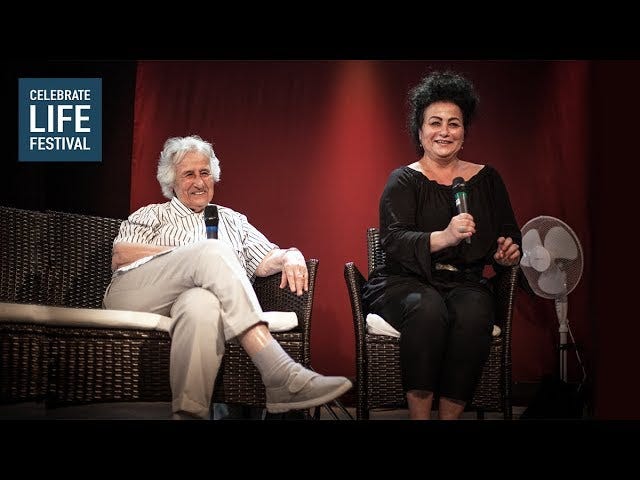
Holocaust survivor Anita Lasker-Wallfisch with her daughter Maya Jacobs-Wallfisch
at the 2017 Celebrate Life Festival hosted by Thomas Hübl
I’m really inspired by the generosity. It really moves me because it’s something that I have been hungry for my whole life.
I said to a few people earlier, who happen to be therapists: don’t tell me what model you are, tell me if you’re good and tell me if you’re kind - and, if you’re funny as well, then that’s a real bonus!
These for me are the core human conditions - and, of course, intelligence - that allow us the possibility of change and which allows people to connect and why you guys are all here.
And I also notice, which is beautiful, you all seem to smile. I haven’t looked at everyone’s face, but the faces that I’ve noticed - you’re all open and smiling and engaged.
This is unusual.
I mean, I know this is an unusual gathering. True, but there’s a lot of you. I said ok, this is something special happening here and I love that.
You know, people are making eye contact with each other, and there’s something - on a cellular level, which is I think where healing can really happen.
And I think we’ll all remember this, these moments. And that’s a wonderful thing.
- Maya Jacobs-Wallfisch, speaking at 2017 Celebrate Life Festival
I recently became interested in the work of Thomas Hübl, a spiritual teacher whose work is focused on questions of collective and trans-generational trauma. I learned about Hübl from Matthew Green, a journalist and co-host of the What Is Collective Healing? podcast associated with Hübl’s Pocket Project.
I met Matthew through The Resonant Man, an online group for men who are focused on cultivating more rooted relationality in the midst of the increasing global chaos, which he co-leads along with Jacob Kishere. Like Hübl, Matthew and Jacob emphasize the importance of developing awareness of the collective field, the energetic spaces between us which we are always co-creating together.
Exploring Hübl’s work, I came across a live discussion he hosted with the holocaust survivor Anita Lasker-Wallfisch, a German-British cellist and one of the last known survivors of the “Girls’ Orchestra” of Auschwitz. She was joined onstage by her daughter, Maya Jacobs-Wallfisch, a psychoanalytic psychotherapist and co-founder of the Forum for Transgenerational Trauma in the UK.
For nearly two hours, this remarkable mother-daughter duo unpack the many-layered repercussions of Anita’s experience in Nazi concentration camps, her rescue by British soldiers, her subsequent life in the UK and how the patterns of the trauma she lived through marked her relationship to her daughter.
Maya didn’t learn what her mother had been through until she was a young woman. Nonetheless, she felt a profound sense of “unbelonging” during her adolescence, resulting in her own struggles with addiction, hyperarousal, and anxiety. She had a clear experience that something wasn’t right, but didn’t know what it was.
Despite the painful themes, this discussion is warm, insightful, deeply human and truly rewarding to listen to. I highly recommend it.
Although a lot more could be said about their presentation, above all I want to highlight Maya’s words at the top of this article about the welcome she felt at this festival where she found people to be open, engaged and curious.
In contrast, describing the experience of Holocaust survivors after the end of World War II, Anita said,
“We wanted to be asked, when we first came out of this mess - we wanted to be asked, but nobody asked any questions. We fell into a huge hole of silence.”
The stories of these two remarkable women are a potent reminder that it is the simplest of things we do for each other that make the biggest difference. Yes, there are professionals whose specialized training gives them invaluable skills to understand the complexity of helping survivors of harrowing traumas to process the horrors they lived through so they can move back towards a sense of wholeness.
However, anyone can care. Anyone can make eye contact. Anyone can smile.
Anyone can momentarily put aside their other concerns to give their full attention to another person who is sharing their experience.
Anyone can hold the intention that other people around them feel welcome.
So, why does Maya remark that encountering these qualities is “unusual”?
Perhaps because for some of us, the assertions above about what ‘anyone’ can do don’t ring true at all.
Yes, theoretically, I could smile or make eye contact with any person I meet - so why do I sometimes avoid doing those things at all costs?
Recently, a client of mine told me that he was not a very caring person.
I asked him, “Who in your life has modeled for you what caring looks like? Did you feel cared for when you were growing up?” In light of these questions that he had never asked himself before, suddenly it didn’t seem so obvious that he “should” care.
Our social commitments to each other are the source of all great human accomplishments, but we have reached a point in our evolution where the experience of caring seems “unusual” to many of us - because we so rarely encounter it.
Yet, once we do experience care - and experience it repeatedly - we discover that our bodies, minds, hearts and souls can rest in a more grounded and resonant frequency. We discover that we are capable of so much more than we thought.
While the institutions that have socialized us, the automaticity of the algorithms and the violence of world events might suggest that we must “think fast!” and “do something!” when we practice slowing down, doing nothing, and feeling more, we become so much more attuned to the space between us where all of our potential lies.
The four postures of love - kindness, connection, curiosity, play - offer us a simple framework for recovering our in-born human capacity for cooperation. Some begin or experience life in such a way that they have more skills than others, but the more capacity each one of us develops, the more capacity is developed by the collective.
I hope you’ll join me this week for guided meditation, partner and group dialogue, journaling and somatic movement at the 4 Postures of Love workshop. You can attend on Tuesday at 1pm EST or Thursday at 8pm EST.